
On Monday you do seven push-ups with your hands on the gym bench you’ve used all month. Three weeks ago you managed five before your hips started to sag. You write down seven, take a drink and open your phone. The first thing you see is a sharply defined torso under gym lighting, with a caption about showing up every day. By the time you get to the locker room, you’re thinking about your stomach. You’ve already forgotten the two reps.
That’s a bad trade. The set gave you something you could use to plan the next session. The picture made you feel as though a stranger’s outline was a better measure of what you’d just done. With a generated image, even the stranger may be fictional.
Look for the session behind the picture
A fitness photo can show you how someone posed. A training video can show you how they moved. When you’re deciding what to do at the gym tomorrow, look for the details that would let you try the movement yourself. Where are their hands? How high is the bench? Do they lower themselves to the same point on every rep? A useful demonstration lets you answer those questions without needing to know what the person’s waist looks like.
Lighting and timing already complicate comparisons between real photos. Think of how different your arms look right after a set of rows compared with the next morning while you’re making coffee. Put the same person under a hard light from above and then beside a window on an overcast day. You’ll see different shadows. With a generated physique, there may be no person who trained, rested or got photographed.
An image made with a generator such as JOI’s AI nude art tool can make a fictional adult look like someone posing for a studio photograph. That can work as an illustration. If the image turns up beside a caption about six weeks of training, the physique alone gives you no way to check the claim. Look for what the post shows about the training itself. Plenty of posts will come up short even when the photos are real.
Knowing an image is synthetic may do less for the way you feel than you’d expect. In a 2026 experiment on AI-generated influencer images, 296 women who regularly used social media rated ten images. One group was told the images were generated. Both groups reported lower body satisfaction immediately afterward. Everyone saw generated images, so the result concerns what happened with and without disclosure. If a post leaves you comparing stomachs, knowing how it was made can still leave you making the same comparison.
Keep the setup the same long enough to learn something
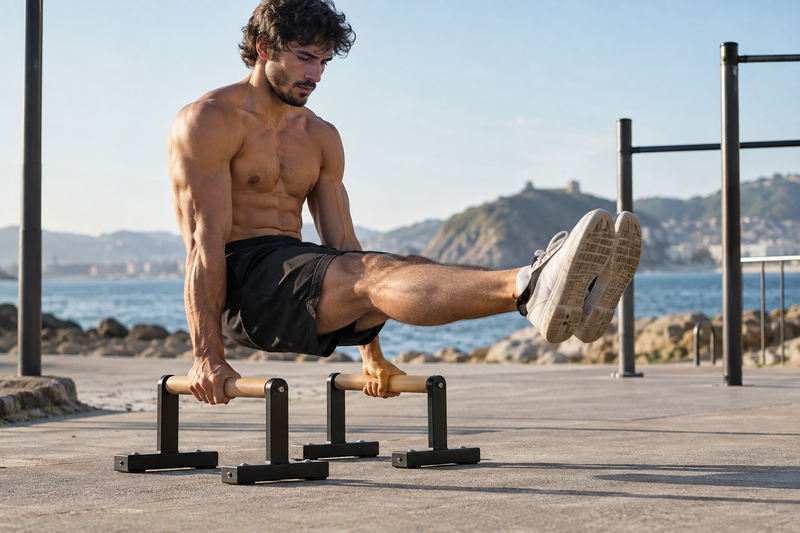
Fitness Talk’s guide to choosing parallettes for calisthenics explains how the height of the bars changes what you can do on them. The same detail matters when you look back at your sessions. Seven push-ups on a higher bench and five on a lower one describe two different tasks. Write down which bench you used, along with your reps. If you change the height, give the new version its own entry.
Choose one or two movements you already do and record what you can repeat. For a dumbbell row, note the weight, the reps on each side and whether you supported yourself on a bench. For a push-up, note the bench height and how far you lowered yourself. Keep the notes short enough that you’ll still write them down when the gym is closing and someone is waiting for your spot.
Effort belongs in the log, too. Eight reps with the last one barely moving feel different from eight where you’re confident you could do another two with the same form. You can write “two left” or “last rep hard.” It’s your best estimate. If the same set starts feeling easier across a few sessions, you’ve learned something even before the rep count changes.
The entry can fit on one line. “Monday, flat bench by the wall, seven reps, last one hard.” If you come back on Thursday and get seven with a little room to spare, write that down, too. Next week you’ll have two entries that make sense together, even if you can barely remember Thursday’s workout.
Give yourself a few sessions to see the change
A training log can turn into another thing you check too often. One bad session is particularly easy to overread. If you had to rush your warm-up and cut your rest short, jot it down next to the numbers. You’ll have a better account of why Friday felt harder when you read it next month. Look at several comparable sessions before deciding you need to change the whole workout.
Say you’ve spent a month on those bench push-ups. Your best set has gone from five to seven, and last week you hit seven twice. You can keep the same setup and see how it goes next time. You can also try a slightly lower surface and log a new starting point. If the number drops at the lower height, the old entry still tells you what happened at the previous one. You get to keep both pieces of information.
Photos can stay in the mix if you enjoy taking them. If your aim is to see whether you’re keeping your hips steady, take a short side-on clip of the set. Frame the bench and your whole body so you can see what changed from the first rep to the last. Watch it once with a specific question in mind. Did your hips start to drop on the last rep? If they did, that gives you something to pay attention to next time.
The next time you finish a set and reach for your phone, open the log while you still remember how the last rep moved. In a month, you’ll be glad you wrote down which bench you used. You probably won’t remember the torso you scrolled past on the way to the locker room.
About The Author