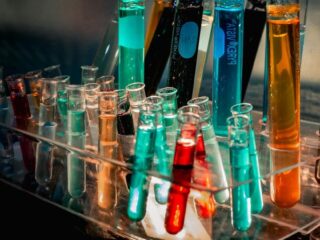

A bottled drink or shot that contains 7-OH answers to two separate sets of rules. Drug-scheduling law asks how concentrated the product is. Food law asks a different question entirely: whether the ingredient may be in a food or drink at all. For 7-OH, federal regulators have already answered that second question, and their answer is no.
As of late October 2026, nothing from DEA on 7-OH scheduling had yet appeared as a final order. DEA’s October paperwork names a floor rather than a firm date: on or after November 13, 2026. The listing would bind from whatever day it finally prints. Dates like that slip, so look at the newest DEA entries in the Federal Register before you lean on any summary, mine included.
Why does food law reach a 7-OH drink at all?
Because a drink is food. The federal food and drug statute (the FD&C Act) defines food to include articles used for food or drink, along with their components (21 U.S.C. 321(f)). A ready-to-drink shot or a powdered drink mix sold for people to consume sits inside that definition, whatever the label calls it.
FDA’s position on 7-OH in food is direct. In its 29 July 2025 announcement, the agency said 7-OH cannot lawfully be added to conventional foods and is not lawful in dietary supplements. It also said there are no FDA-approved 7-OH drugs. So every ordinary route a consumable product takes to market is closed to it.
Kratom itself fares no better. According to FDA’s kratom page, the plant has no lawful US market status as a drug, and the same goes for supplements and conventional food. The agency’s reasoning runs through two findings. It calls kratom a new dietary ingredient lacking enough safety information, so a supplement with kratom in it counts as adulterated. And once kratom goes into food, FDA classes it as an unsafe food additive.
It helps to keep the two compounds apart here. Mitragynine is kratom’s primary alkaloid. 7-OH (7-hydroxymitragynine) is a minor one: in natural leaves, by FDA’s figures, it accounts for less than 2% of the alkaloid content. The DEA notice targets 7-OH and a related compound called mitragynine pseudoindoxyl (MP). It does not schedule mitragynine or the plant. Food law, by contrast, reaches both kratom and 7-OH.
Did FDA’s warning letters cover drinks?
Yes. On 15 July 2025, FDA announced warning letters to seven companies selling 7-OH products. Drink mixes and shots were on the list of product types, next to tablets and gummies. Packaging a product as a beverage didn’t put it in a separate category. It simply added food law to the problems.
FDA’s kratom page also explains why food regulators are paying attention. FDA has flagged kratom products found to carry Salmonella or heavy metals. Its advice to consumers is blunt: don’t use kratom. That warning is grounded in reports of serious adverse events, and FDA names liver toxicity and seizures among them. Those are FDA’s statements, and they’re the basis for classing kratom in food as unsafe.
How is California using food law against these products?
California shows how far food law can go without any kratom statute. The state has none. Even so, the California Department of Public Health sent a letter dated 9 January 2026 to processed food registrants and licensees saying that selling or marketing kratom and 7-OH products for consumption is unlawful. The letter calls any product containing them adulterated and illegal to sell to people of any age, citing Health and Safety Code section 110555.
A week later, CDPH’s 16 January 2026 news release named the Sherman Law, California’s own food and drug statute, as the source of its authority over adulterated or misbranded food and drugs. The release said food and dietary supplements containing kratom or 7-OH are adulterated under both federal and state law. It also noted that beverages and shots are among the formats these products typically come in.
That matters beyond California. A state doesn’t need to schedule anything to pull a 7-OH drink off a shelf. It can act through its food safety program, using inspectors and registration rules that already exist for every processed food maker.
How does Florida’s rule handle beverages?
Florida took the scheduling route instead, and it spelled out liquids. Its emergency rule 2ER26-2 has been in force since 18 August 2026. The rule draws its Schedule I line for drinks at 1 mg of 7-OH per milliliter, and it names beverages and tinctures outright, with a matching 1 mg/g line for solids. It also catches products with fewer than 100 parts mitragynine to 1 part 7-OH.
This isn’t the state’s first attempt, since Florida has gone through five emergency 7-OH rules since August 2025, the latest in August 2026, and 7OH.com’s Florida guide traces that sequence and the open question of how long the present rule lasts. That expiry point is worth watching. Section 893.035(9) of Florida’s statutes gives reported emergency rules a sunset: they end on the next June 30 unless lawmakers make them permanent. Read that way, the present rule runs out on 30 June 2027.
The proposed federal test uses the same per-milliliter line for liquids. Because a drink is measured by volume, a lab result for one only lines up with either rule when it’s stated per milliliter. A total figure for the whole container can’t be compared directly.
What happens when both systems apply at once?
They work on different logic. Scheduling is a threshold question: above the line, the product is a controlled substance. Food law, as FDA applies it here, is a status question. FDA’s position that 7-OH can’t lawfully be added to conventional food carries no threshold at all.
So a drink that tests below the DEA threshold isn’t thereby lawful. DEA said as much in its October notice, warning that no one should infer below-threshold material is safe, and it still calls kratom and both alkaloids drugs of concern. DEA also said federal scheduling doesn’t override stricter state law. Ten states, including Alabama and Indiana, already prohibit 7-OH outright.
My view is that, for a beverage, the threshold debate is the second question rather than the first. I’d take the food-law position as the starting point and the scheduling line as an additional exposure on top. None of this is legal advice, and a lawyer in your state can tell you how its agencies apply these rules.
What can you check on a drink’s label and lab report?
Start with the certificate of analysis, and make sure the batch or lot number on it matches the one printed on the container. A COA describes one sample from one batch. If the numbers don’t match, the report tells you nothing about what’s in your hand.
Next, look at the units. Liquid results should be stated per milliliter, and the walkthrough at 7oh.com/blogs/news/how-to-read-a-7oh-products-lab-report shows how per-milliliter results relate to per-gram ones on a typical report layout. Watch the reporting codes too. “ND” means below the limit of detection, not zero, and “<LOQ” means the compound was detected but couldn’t be measured precisely.
Check whether the panel reports MP at all. Where MP is present, the federal ratio puts mitragynine over 7-OH and MP combined, so a report without an MP figure leaves the sum unfinished. And check the lab itself. Whether it holds ISO/IEC 17025 accreditation is a quick lookup in either the A2LA directory or the ANAB one.
Last, read the label for words like “dietary supplement.” FDA has said 7-OH isn’t lawful in supplements, so a drink making that claim is telling you something about how carefully it was put together.
What this can’t settle yet
Two gaps remain. Neither the DEA notice nor Florida’s rule says which testing method or sampling plan applies. Nor does either say how ND results or measurement uncertainty are handled. And the federal order itself hasn’t been published, so its final wording could differ from the notice. Food law doesn’t share that uncertainty. FDA’s position on 7-OH in conventional food has been on the record since July 2025, and it doesn’t depend on a threshold at all.
About The Author