How to Choose Parallettes for Calisthenics: 7 Things to Check Before Buying
 Marsha Stevenson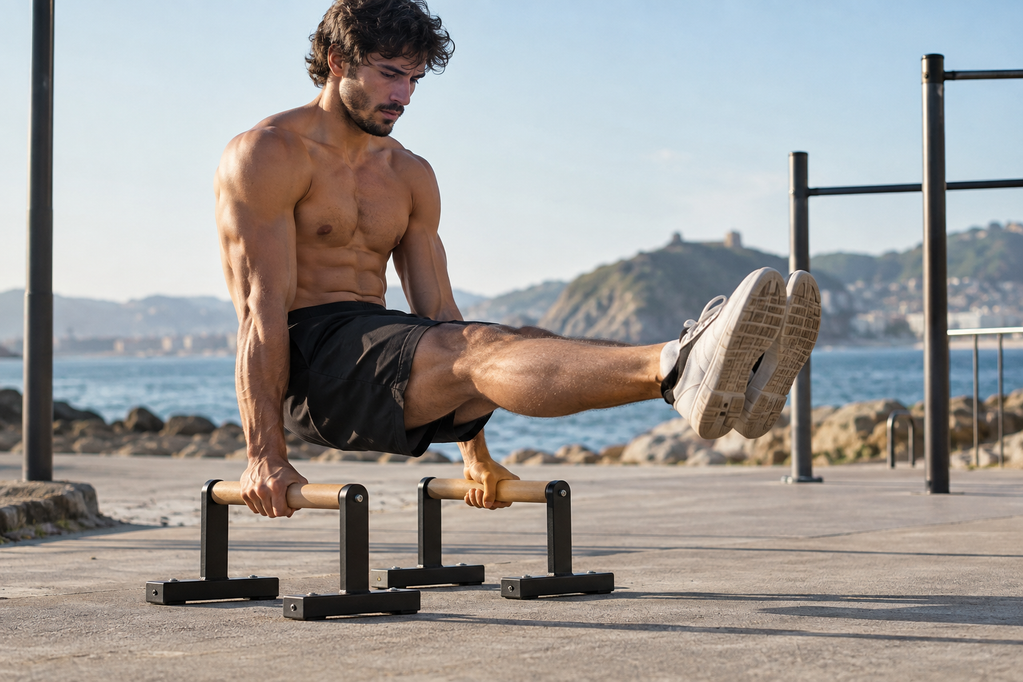
Things to Check Before Buying
Parallettes look simple. Two handles, a base, done. But spend five minutes comparing pairs online and you’ll notice they’re all over the map: different heights, different handle shapes, and wildly different claims about how much weight they can take. Some of that matters a lot. Some of it is marketing.
If you’re using parallettes for push-ups, L-sits, handstand work or planche progressions, here’s what’s actually worth checking before you buy.
Stability first
This is one of the easiest things to overlook. Parallettes need to stay put when you shift your weight, especially mid-handstand, when the last thing you want is a wobble.
Check the base. A wider footprint, or one that’s shaped to spread your weight properly, cuts down on unwanted movement. But base width isn’t the whole story. The join between handle and frame matters just as much. You can have a frame that looks bombproof and still get flex at the joint if the construction is cheap.
If a brand publishes load-testing data, that’s a better signal than photos or marketing copy.
Grip diameter (this one’s underrated)
Handle thickness gets glossed over, but it changes everything about how a session feels. Too thin, and your grip gives out before your muscles do. Too thick, and smaller hands just can’t close around it properly.
Most people land on a medium diameter as the sweet spot: enough surface area to feel secure without turning into a forearm workout. Finish matters too. Smooth wood tends to feel more natural in the hand than anything with sharp edges or an awkward profile.
Don’t assume all parallettes use the same handle size. They really don’t.
Height changes what you can do
Lower sets keep you close to the ground, which is fine for push-ups, L-sits and basic support work.
Go higher and you get more clearance underneath, which opens up handstand variations and deeper presses.
There’s no “correct” height here. It comes down to your body, your training style, and what you actually plan to do on them. If you want one pair that covers a bit of everything, aim for enough clearance without going unnecessarily tall.
What they’re made of
Wood handles, such as beech or birch, are popular for a reason: they feel natural in the hand and hold up over long sessions. The frame is the other half of the equation. Powder-coated steel gives you rigidity and some protection against wear.
Here’s the part people miss: it’s not just the materials, it’s how they’re joined. A great handle bolted to a mediocre frame connection is still a mediocre product. Ask how it’s assembled, and whether the manufacturer has actually tested it.
Weight and portability
Heavy parallettes feel solid. There’s something reassuring about that. But solid also means annoying to carry to the park, the gym, wherever you train.
If you’re training at home and they’re not moving, weight barely matters. If you’re hauling them around regularly, a lighter, more compact design earns its keep fast. Worth checking, too, whether the pair packs together neatly. A set that eats half your gym bag gets left at home more often than it should.
The load number that actually matters
This is where a lot of listings get vague, and it’s worth slowing down on.
Your body weight isn’t the only consideration. Dynamic movements can introduce additional forces and loading on the frame, so a clearly stated rated load is more useful than simply seeing a large number in bold.
Take the Xtenia Antlettes V2 as an example: beech handles, a powder-coated steel frame, a 35 mm grip, and a rated load of 300 kg. They’ve also been independently tested by SGS to 1,280 kg before failure. That test result should not be interpreted as a usable load. Instead, it demonstrates that the structure withstood substantially more than its rated load under the test conditions. It’s important not to confuse a manufacturer’s rated load with a destructive test result: the rated load is the figure intended for regular use, while the test-to-failure result shows how the structure performed beyond that rating.
If you’re progressing toward heavier static holds, that distinction is genuinely useful to know before you buy.
What happens after you buy
Nobody thinks about the warranty until they need it, which is exactly why it’s worth five minutes now.
Parallettes take a beating over time: repeated load, grip pressure, being dragged in and out of a bag.
A brand that backs its construction with a real structural guarantee is telling you something. Read the fine print, though: some guarantees cover the structural frame, while others treat finishes or wear and tear separately.
Bringing it together
None of these seven things matter equally for everyone. Someone doing push-ups a few times a week doesn’t need what a planche-focused athlete needs. Be honest about where you are and what you’re working toward, and let that decide what you prioritize.
Quick checklist:
- Stability: Does the base actually stay put?
- Grip diameter: Comfortable and controllable?
- Height: Enough clearance for what you do?
- Materials: Are the handle and frame both solid, and solidly joined?
- Weight: Realistic to carry if you need to?
- Structural strength: Is the rated load clearly stated?
- Durability: Does the warranty actually mean something?
Get these right and you’re not just buying parallettes that look good in photos. You’re buying a set that’ll hold up as your training gets harder.
About The Author